1
/
of
8
Xevqoriniks
Cipher Framework
Cipher Framework
Regular price
€123,00 EUR
Regular price
Sale price
€123,00 EUR
Taxes included.
Couldn't load pickup availability
Share
- 💾 Digital file available after purchase
- 📚 Long-term availability
- 🔐 Secure checkout
- 🗓️ Content updated in 2026
Colection Progress
Self-paced learning overview
Progress is self-managed based on completed modules.
Self-paced learning overview
1. Problem Statement
After studying foundational concepts related to digital identity, user permissions, and network communication, the next challenge is working with larger collections of events and records. A single event record does not always provide enough context to explain what is happening within a digital environment. Learners may find it difficult to connect time, source, activity type, and context into one coherent sequence. Without a structured approach, analysis can become a review of disconnected information. Continued study therefore benefits from learning how to connect events and develop a logical explanation of what happened.
2. Solution
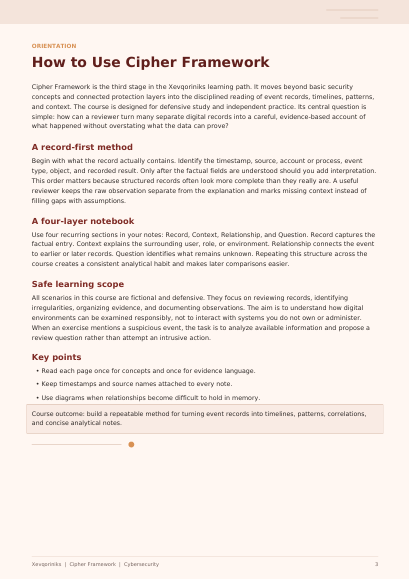
Cipher Framework teaches learners to review digital events as parts of a connected sequence rather than as isolated records. The materials explain how to organize information by time, source, activity type, and context. Educational examples demonstrate how to compare events and identify recurring or unusual patterns. Exercises focus on building timelines and writing concise analytical observations based on the provided information. The final section combines several information sources into one structured learning scenario.
3. What's Inside
- Module 1: Event Data Structure — learn which fields may appear in digital records and how to read timestamps, identifiers, event types, and other contextual elements.
- Module 2: Building Timelines — learn how to arrange events chronologically and create activity sequences for further review.
- Module 3: Comparing Event Sources — examine how records from different educational sources can be compared and connected.
- Module 4: Pattern Recognition — study ways to identify recurring actions, behavioral changes, and unusual sequences within learning datasets.
- Module 5: Context and Correlation — explore why an individual event may have different meaning depending on timing, user activity, earlier events, and broader context.
- Module 6: Incident Indicators — review neutral educational examples of signs that may indicate a need for additional examination of digital activity.
- Module 7: Writing Analytical Notes — learn how to record observations, facts, and logical conclusions in a concise and structured format.
- Module 8: Multi-Source Review Scenario — bring the course material together through a broader educational exercise involving several types of digital records.
✅ Suitable if you:
- already understand foundational cybersecurity concepts;
- are familiar with accounts, permissions, and event records;
- want to work with structured digital information;
- are interested in building timelines;
- want to understand relationships between events;
- want to develop a more analytical approach to learning scenarios;
- plan to continue with later Xevqoriniks courses.
- have not yet studied foundational concepts related to digital events and records;
- are looking for materials focused only on one narrow subject;
- expect instructions involving unauthorized activity within digital environments belonging to others;
- do not plan to work with event tables, structured examples, or learning scenarios.
While working through Cipher Framework, you will study how to:
- read the structure of digital records;
- understand the role of timestamps;
- build event sequences;
- compare records from different sources;
- identify recurring activity patterns;
- recognize unusual behavioral changes;
- consider context during analysis;
- prepare concise analytical notes;
- separate facts from assumptions;
- combine multiple events into a structured learning scenario;
- determine which records may require further review;
- organize analytical findings in a clear format.
Cipher Framework includes a 30-day period for submitting a refund request under the Xevqoriniks Refund Policy. Detailed conditions for digital educational materials are described separately in the store’s refund policy.
7. Certificates & Credentials
After completing Cipher Framework, Xevqoriniks provides a certificate confirming completion of the learning materials included in this course.
Do I need previous cybersecurity experience?
Do I need previous cybersecurity experience?
No. Xevqoriniks courses follow a progressive structure, with introductory materials covering foundational concepts and later tiers moving into more detailed topics. Each course explains who it is intended for and which subjects are covered within its modules.
How are the learning materials structured?
How are the learning materials structured?
Each course is divided into themed modules containing explanations, examples, learning scenarios, and practical exercises. The materials cover digital security, data handling, event analysis, protection principles, and other subjects depending on the course tier.
Is a certificate provided after completing a course?
Is a certificate provided after completing a course?
Yes. After completing the learning materials for the selected course, Xevqoriniks provides a completion certificate showing the course title.